Season of Hell’s Legacy introduces a new collection of Runes to Diablo 4, expanding the existing Runeword system with additional ways to generate and spend Offering.
The new additions are divided between Ritual and Invocation Runes, including several effects designed specifically around mechanics introduced during Season 15.
These Runes are also used in new Runeword Item recipes, allowing specific combinations to be transmuted with Common equipment through the Horadric Cube.
All New Runes in Season of Hell’s Legacy
There are 12 new Runes introduced with Season of Hell’s Legacy, consisting of five Ritual Runes and seven Invocation Runes.
Ritual Runes determine how Offering is generated, while Invocation Runes consume Offering to activate their listed effect.
Rune | Type | Effect |
Amn | Ritual | Gain Offering when you deal Thorns Damage. |
| Eth | Ritual | Gain Offering after avoiding Primary Resource spending while fighting for 5 seconds. |
Mal | Ritual | Gain Offering when you invoke your Prime Evil Power. |
| Ort | Ritual | Gain Offering when dealing Non-Physical Direct Damage. |
Tal | Ritual | Gain Offering when dealing Damage over Time. |
| Ber | Invocation | Your next several Skills gain Lucky Hit Chance to deliver a Crushing Blow. |
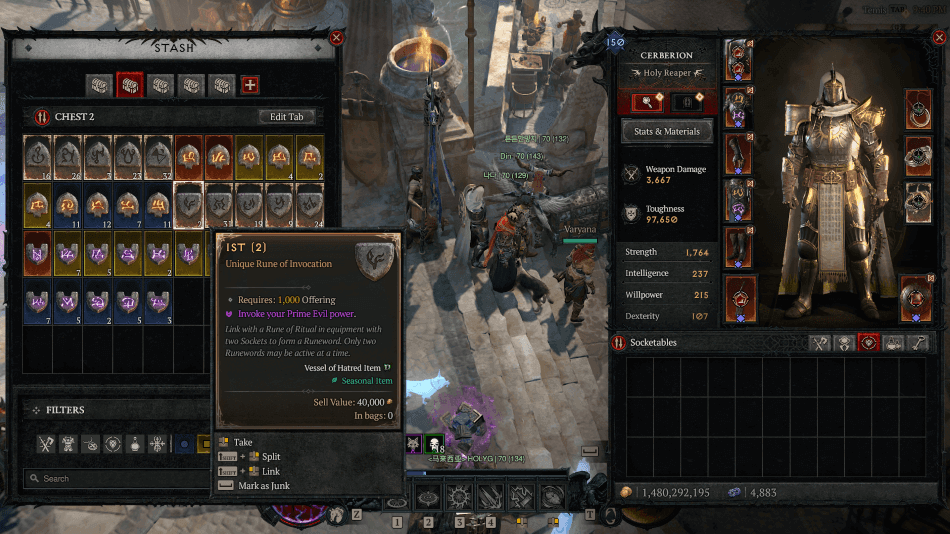
Ist | Invocation | Invokes your Prime Evil Power. |
| Ith | Invocation | Temporarily increases Weapon Damage and can stack multiple times. |
Lo | Invocation | Temporarily increases Deadly Strike Chance. |
| Ral | Invocation | Temporarily increases Gold Find. |
Sol | Invocation | Temporarily grants Damage Reduction. |
| Tir | Invocation | Temporarily grants additional Primary Resource on Kill and can stack. |
New Ritual Runes
The five new Ritual Runes are Amn, Eth, Mal, Ort, and Tal, providing new conditions that can be used to generate Offering during combat.
Their triggers cover several different playstyles, including Thorns, Damage over Time, Non-Physical Direct Damage, and builds capable of fighting without constantly spending Primary Resource.
Mal is particularly tied to Season of Hell’s Legacy, generating Offering whenever your active Prime Evil Power is invoked.
Amn
Amn generates Offering whenever you deal Thorns Damage, giving Thorns-focused builds another way to power their Invocation Rune during combat.
Since the trigger depends on Thorns rather than directly casting a particular Skill, its usefulness largely depends on how consistently your build can deal Thorns Damage.
Eth
Eth rewards builds capable of fighting without continuously spending their Primary Resource, generating a large amount of Offering after meeting its combat condition.
This makes it better suited to builds that can rely on cooldowns, Basic Skills, or other mechanics for periods without consuming their primary resource.
Mal
Mal generates Offering whenever you invoke your Prime Evil Power, directly connecting the existing Runeword system with Season 15’s Prime Evil mechanics.
Its usefulness therefore depends heavily on your Prime Evil Power and how frequently your build can trigger it during combat.
Ort
Ort generates Offering by dealing Non-Physical Direct Damage, allowing elemental and other non-physical builds to accumulate Offering through regular attacks.
Unlike Runes with longer activation requirements, Ort can continually generate Offering as long as your attacks satisfy its damage condition.
Tal
Tal generates Offering whenever you deal Damage over Time, making it a natural option for builds that regularly apply persistent damaging effects.
Frequent Damage over Time applications can continually contribute Offering toward whichever Invocation Rune you pair with Tal.
New Invocation Runes
Season of Hell’s Legacy adds seven new Invocation Runes, with Ber, Ist, Ith, Lo, Ral, Sol, and Tir providing several new effects for Runeword combinations.
Rather than generating Offering, these Runes consume the Offering produced by your Ritual Rune to activate effects ranging from additional damage and defense to Gold Find.
Ist is the most directly connected to the seasonal mechanic, allowing accumulated Offering to invoke your currently active Prime Evil Power.
Ber
Ber enhances your next several Skills with an increased chance to deliver a Crushing Blow, providing another offensive option for builds capable of generating enough Offering consistently.
Its limited number of empowered Skills means timing the activation around your stronger attacks can help you get more value from the effect.
Ist
Ist spends accumulated Offering to invoke your Prime Evil Power, making it one of the most distinctive new Invocation Runes introduced during the season.
Because the effect depends on your active Soul Splinter, its result changes according to which Prime Evil Power you currently have equipped.
Ith
Ith temporarily increases your Weapon Damage, with the bonus capable of stacking as you continue satisfying its effect.
This makes it an offensive Invocation option for builds looking to build additional Weapon Damage during sustained combat.
Lo
Lo grants additional Deadly Strike Chance for a limited duration after enough Offering has been accumulated.
It provides a straightforward offensive effect that can be paired with Ritual Runes capable of repeatedly reaching its Offering requirement.
Ral
Ral temporarily provides a substantial increase to Gold Find, making it considerably different from the combat-focused effects offered by most Invocation Runes.
Its main value is therefore farming rather than directly increasing the damage or survivability of your build.
Sol
Sol grants temporary Damage Reduction, providing a defensive Invocation option among the new Season 15 Runes.
This can be particularly useful when additional survivability is more valuable than adding another offensive effect to your build.
Tir
Tir temporarily increases the amount of Primary Resource gained from kills, with the effect capable of stacking during its duration.
It works particularly well during content with large groups of enemies, where frequent kills allow you to continually benefit from the additional resource generation.
How To Use the New Runes?
The new Runes continue to use Diablo 4’s existing Runeword system, meaning you need one Ritual Rune and one Invocation Rune socketed into the same piece of equipment.
Your Ritual Rune generates Offering whenever its listed condition is fulfilled, while the Invocation Rune activates once its required amount of Offering has been accumulated.
This means the best combination depends on both how reliably your build can trigger the Ritual Rune and whether the Invocation effect provides something your build actually needs.
All Runeword Items and Effects
There are currently 19 Runeword Items available through Horadric Cube recipes, with each producing a Unique item based on classic Runewords from Diablo II.
Each comes with its own affixes and, in many cases, a special effect that can significantly change how the item works with your build.
Runeword Item | Effects |
Ancient’s Pledge | Provides substantial Damage Reduction alongside increased Cold, Fire, Lightning, and Poison Resistance. |
Call to Arms | While affected by a Shout, increases all Skill Ranks, Maximum Life, and Maximum Primary Resource. |
Edge | Provides increased damage against Demons and Undead, Attack Speed, Thorns, All Stats, and a Lucky Hit Poison effect. |
Enigma | Changes your Evade into the Sorcerer’s Teleport at the cost of Primary Resource, while providing Movement Speed, Damage Reduction, Maximum Life, and Skill Ranks. |
Grief | Provides additional Weapon Damage, Deadly Strike Chance, and increased Poisoning damage. |
| Holy Thunder | Provides several Lightning-focused bonuses and additional offensive effects. |
Infinity | Provides powerful offensive bonuses while applying effects based around elemental damage and enemy defenses. |
| Insight | Provides offensive bonuses alongside additional resource-focused effects. |
King’s Grace | Provides additional damage and bonuses particularly suited to fighting Demons and Undead. |
| Leaf | Provides bonuses focused around Fire damage and Fire-based Skills. |
Lore | Provides Skill bonuses and additional defensive benefits from a Helm slot. |
| Pattern | Provides offensive bonuses centered around faster attacks and Poison damage. |
Phoenix | Can unleash powerful Fire effects, including Ring of Fire when leveling and Fire Spear through Lucky Hits. |
| Prudence | Provides a collection of defensive bonuses through Chest Armor. |
Rain | Lucky Hits can unleash a Rank 15 Druid Tornado, while dodging can trigger Rank 15 Cyclone Armor. |
| Spirit | Provides a mixture of Skill, resource, and offensive bonuses. |
Stealth | Provides Movement Speed, Attack Speed, Resource Generation, Damage Reduction, and changes Evade into Sorcerer’s Teleport. |
| Strength | Provides offensive bonuses through compatible one-handed weapons and off-hands. |
Zephyr | Unleashes a Dust Devil whenever you Dodge while also providing Attack Speed, Movement Speed, Dodge Chance, and additional damage. |
How To Craft Runeword Items?
To create a Runeword Item, obtain a Common version of the required equipment along with every Rune listed for the recipe you want to craft.
Place the Common base and required Runes inside the Horadric Cube, then transmute them together to create the corresponding Runeword Item.
The Runes are consumed as crafting ingredients rather than being socketed into the base, making this system completely separate from creating a normal Ritual and Invocation Runeword.
To learn how to craft each of these items and find the required Runes and base equipment, check out our New Horadric Crafting Recipes Guide for the complete list of Runeword Item recipes.
Diablo 4: New Horadric Crafting Recipes (New Recipes and Runeword Recipes)
Verdict
Season of Hell’s Legacy expands Runes beyond the combinations already available, adding new Ritual and Invocation effects that support several different builds and seasonal mechanics.
The addition of Runeword Items also gives Runes another purpose outside socketing, with 19 recipes recreating several recognizable pieces of equipment from previous Diablo games.
Keep the new Runes you find even if they do not immediately fit your build, as they may be useful for another Runeword combination or one of the new Horadric Cube recipes.
